
Clinical evidence, where the patient lives.
Vitruvian Shield builds an AI-native clinical evidence platform for hybrid trials and post-market surveillance. Participants report and are followed from home; the study team sees the data in one place, next to the EDC it already uses.

How we fit
Three layers run a study. Vitruvian Shield sits in the third.
Sponsors
Own the study and the EDC.
CROs
Run the study.
Vendors
Supply the evidence layer. Vitruvian Shield sits here, working under CROs and sponsors.
See the platform in action
Vitruvian Shield — Exclusive eHealth CTMS & RPM PaaS
Platform modules
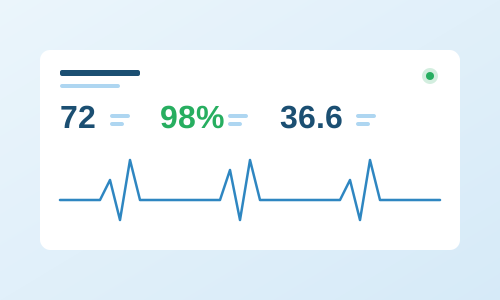
Six modules, one data model. Everything needed to design, run and monitor hybrid and decentralised studies, connected in a single environment. The status of each module is stated on its card.





Technology and ecosystem partners


- European CEO of the Year 2024-2025
- Portuguese National Innovation Award 2024
- APDC Health Award, First Place 2025
- World Summit Awards Portugal 2024 Winner
- Independent KOL expert review completed through IPN healthproof, May 2026
- European CEO of the Year 2024-2025
- Portuguese National Innovation Award 2024
- APDC Health Award, First Place 2025
- World Summit Awards Portugal 2024 Winner
- Independent KOL expert review completed through IPN healthproof, May 2026
Two Ways to Deploy Vitruvian Shield
Pick the product line that matches your scale and integration posture.
Why Vitruvian Shield
Built different from the ground up, not a collection of acquired tools stitched together, but a unified architecture designed for modern clinical research.
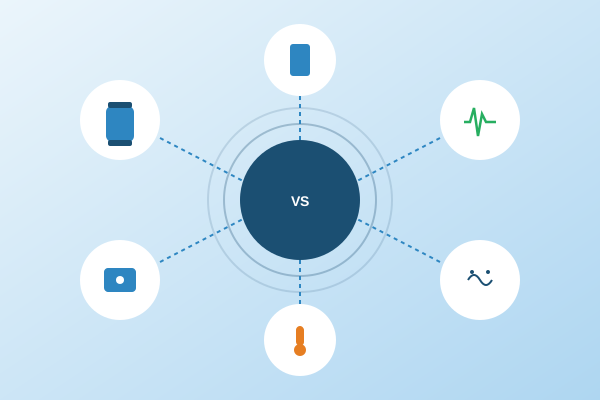
Device-Agnostic
One native research wearable, the Analog Devices Study Watch, and further devices activated per study through our aggregation partnership with Thryve, plus camera-based contactless vital signs (rPPG), in validation. Every source feeds one data model, so a device can change mid-study without breaking data continuity.

AI-Native Architecture
Machine learning isn't bolted on, it's woven into the platform core. From predictive enrollment forecasting to real-time adverse event detection, every module benefits from intelligent automation.
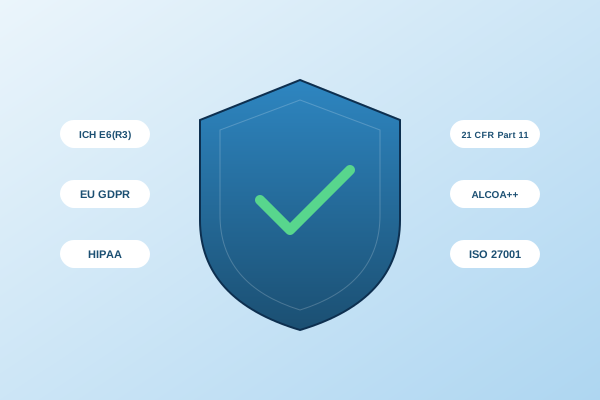
Designed for regulated research
Designed to ALCOA++ data-integrity principles and GDPR requirements, and designed for FDA 21 CFR Part 11 and ICH E6(R3) including Annex 2. Audit trails and access controls are designed so a study can be inspected rather than retrofitted.
AI-Native From the Core
Vitruvian Shield is built AI-native from the core. Three capabilities are in development or in validation; the status of each is stated on its card.
AI-assisted questionnaire and CRF builder
Describe the questionnaire you need in plain language. The builder drafts the electronic CRF structure, validation rules, and skip logic. In development.
AI accessibility assistant for patients completing questionnaires
Patient-facing assistance through study questionnaires, designed to reduce burden for older and digitally less confident participants. In validation.
AI Symptom Checker
Patient triage classification with real-time escalation to investigators for urgent symptom profiles. In development.
Clinical AI on a disciplined timeline
Clinical-decision-support AI (seizure prediction, hypoglycemia forecasting, cardiac arrhythmia detection) is held on a 2027-2029 timeline, explicitly gated on 500+ patients and 6-12 months of longitudinal data per indication. We do not ship clinical AI before the evidence is there.
Why now
Two regulatory timelines are moving clinical evidence into the home.
ICH E6(R3) Annex 2
Annex 2 of ICH E6(R3), covering decentralised elements and pragmatic trials, takes effect in the European Union on 15 January 2027. Sponsors and academic trial units running remote or hybrid elements will need to show how their data flows meet it.
ICH E6(R3) Annex 2 readiness assessmentEU MDR post-market clinical follow-up
EU MDR post-market clinical follow-up obligations push device manufacturers to collect real-world data from devices in use continuously, not episodically.
Post-market surveillance and PMCFThe global decentralized clinical trial market is projected to grow from USD 8.8 billion in 2024 to USD 18.8 billion by 2030, at a 13.7 percent compound annual growth rate.
Source: BCC Research, March 2026
Pricing
One product, three service levels; a fixed-price catalogue of regulatory deliverables; a readiness assessment; an academic programme.
Publishing the price of every regulatory deliverable is a deliberate choice.
One product, three service levels
Level 1
You run it
Platform licence, setup and a per-patient fee; the client runs the study with its own people and sites.
Level 2
We run it
Level 1 plus data management, monitoring and the annual report by the Vitruvian Shield team.
Level 3
We bring the hospital
Level 2 plus subcontracted clinical sites, with hospital costs quoted separately at cost plus 10 percent coordination.
Each level costs the client more per patient than the one below. Platform pricing on request; a quotation follows within one week.
Fixed-price regulatory deliverables
| Deliverable | Price |
|---|---|
| PMCF evaluation report | CHF 12,000 |
| Periodic safety update report | CHF 8,000 |
| Clinical evaluation report update | CHF 18,000 |
| Study protocol | CHF 12,000 |
| Clinical study report | from CHF 30,000 |
| Sponsor validation and vendor-qualification pack | CHF 18,000 |
| Annual regulatory retainer, six deliverables | CHF 65,000 |
Regulatory deliverables need no platform deployment and are available to any sponsor or manufacturer.
ICH E6(R3) Annex 2 readiness assessment
CHF 4,500
Credited in full against a platform contract signed within six months.
Request an assessmentAcademic Research Program
Twelve-month royalty-free licence for non-profit Portuguese research entities.
About the programmeAll prices in CHF, excluding VAT, indicative; the final quotation depends on study scope, device mix and support level. Study devices and their logistics are quoted per study.
0+
Team members across Switzerland, Portugal, Armenia, and the UAE
0
Integrated clinical platform modules
0
Regulated jurisdictions of operation
0
Therapeutic areas in active clinical development
Regulatory Compliance
Designed for regulated clinical research. The status of each framework is stated as designed to, designed for, in progress or targeted.
ALCOA++
Designed toDesigned to ALCOA++ data-integrity principles. ALCOA++ is a set of principles, not a certification.
EU GDPR
Designed toDesigned to GDPR requirements, with a Data Protection Impact Assessment per study, an Article 28 data processing agreement and EU hosting by default.
HIPAA
Designed for alignmentPlatform architecture designed for HIPAA Administrative, Physical, and Technical Safeguards alignment.
ISO 27001
In progressInformation security management system programme in progress at the application layer.
ISO 13485
In progressQuality management system programme for medical device software in progress; no certificate has been issued to date.
ICH E6(R3) GCP
Designed forArchitecture designed for ICH E6(R3), including Annex 2 on decentralised elements, which takes effect in the European Union on 15 January 2027.
FDA 21 CFR Part 11
Designed forElectronic records and audit trails designed for 21 CFR Part 11; formal validation is planned.
EU MDR
TargetedSoftware as a medical device, Class IIb under EU MDR 2017/745; CE marking targeted for 2028 through a notified body.
Advancing Research Across Therapeutic Areas
Purpose built workflows and validated outcome measures tailored to the unique demands of each therapeutic domain.
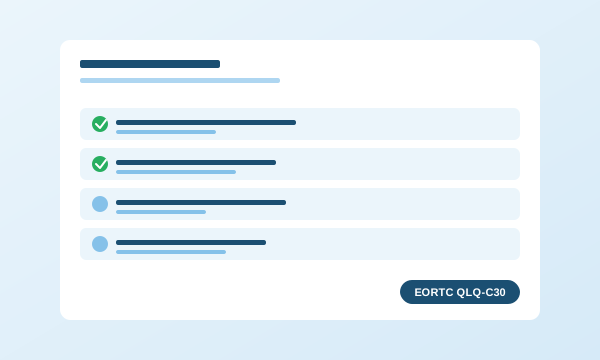

Questions and answers
Frequently asked questions about Vitruvian Shield
What is Vitruvian Shield?
Vitruvian Shield is an AI-native clinical evidence platform for hybrid trials and post-market surveillance. It brings wearable and connected-device data and patient-reported outcomes into one traceable dataset that sits alongside the sponsor's existing EDC. The company is headquartered in Switzerland with entities in Portugal, Armenia and the UAE.
Does Vitruvian Shield replace our EDC?
No. The platform is an evidence layer that works next to the EDC a sponsor already uses, such as Medidata, Veeva or Oracle. Home-collected data carries provenance, identity assurance, a signal-confidence score and an audit trail, and the platform is designed to deliver CDISC and HL7 FHIR exports into that existing stack.
Who uses Vitruvian Shield?
Sponsors running hybrid or decentralised trials, contract research organisations, academic medical centres and hospital research units, and medical device manufacturers who need post-market clinical follow-up and registries. Vitruvian Shield sits in the vendor layer, working under CROs and sponsors.
Which platform modules are available today?
ePRO, remote patient monitoring and eConsent are available. Electronic data capture and AI analytics are in development. CTMS is on the roadmap. Each module page states its own status.
Is Vitruvian Shield certified under ISO 27001, ISO 13485 or CE marked?
No certificate has been issued to date. ISO 27001 and ISO 13485 programmes are in progress, the platform is designed to ALCOA++ data-integrity principles, GDPR, ICH E6(R3) including Annex 2 and FDA 21 CFR Part 11, and CE marking as Class IIb software under EU MDR is targeted for 2028 through a notified body. Hosting is on Microsoft Azure in European Union regions.
How do we start working with Vitruvian Shield?
Request a commercial briefing or a demo. Platform pricing is on request and a quotation follows within one week. The ICH E6(R3) Annex 2 readiness assessment, a fixed-scope review priced at CHF 4,500, is a common first step and is credited in full against a platform contract signed within six months.
Let's Talk
Choose the path that fits your organization. Each route goes directly to the right internal owner.