One platform for home-collected clinical evidence
Wearable and connected-device data and patient-reported outcomes are brought into one traceable dataset that sits alongside the sponsor's existing EDC, designed to support ALCOA++ data-integrity principles and GDPR requirements.
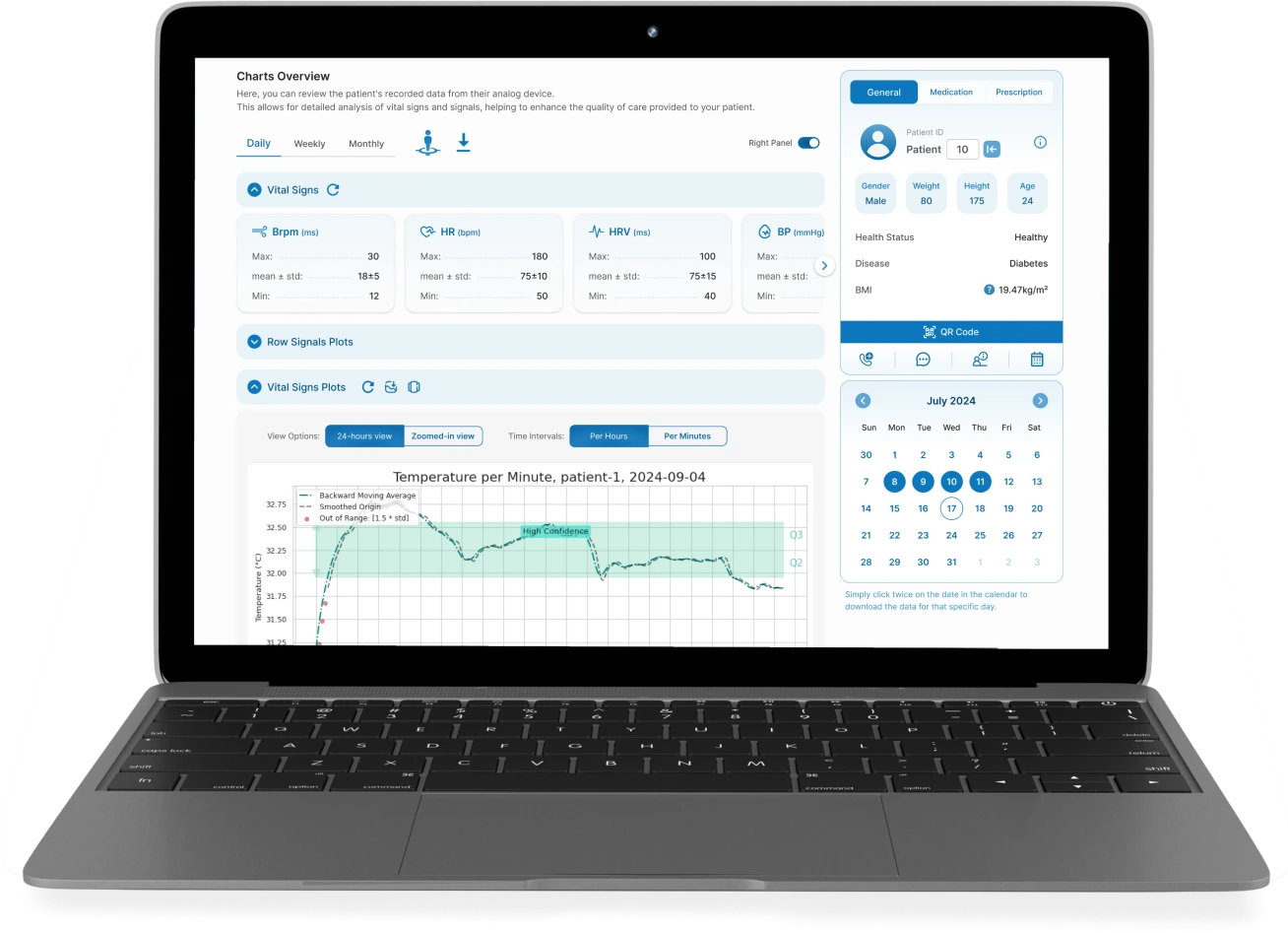
Platform screen with placeholder data
How we fit
Three layers run a study. Vitruvian Shield sits in the third.
Sponsors
Own the study and the EDC.
CROs
Run the study.
Vendors
Supply the evidence layer. Vitruvian Shield sits here, working under CROs and sponsors.
Built from clinical practice, completed in 2025, ready for the 2027 rules.
Years of clinical groundwork. Three years of build. One platform from enrolment to regulatory output.
Clinical work came first
The platform was shaped by clinical work in epilepsy that started years before the first line of code was written in 2023.
No legacy to work around
A new-generation platform completed in December 2025 and on the market since January 2026, with no older architecture underneath it.
Timed for the new rules
It arrives as ICH E6(R3) Annex 2 applies in the European Union from 15 January 2027 and as EU MDR asks device makers for continuous post-market evidence.
API-first architecture
One API. Six modules. A unified data model.
A central API that orchestrates every module. CTMS, EDC, eConsent, ePRO, RPM, and AI all speak a single schema and share a single audit trail.
Hover a module to pause its orbit and see its name. Click to navigate to the module page.
- One developer experience across every module
- Data flows both ways — no silos, no custom middleware
- Audit-trail evidence exported from one place
Illustrative visualisation. Module availability shown in the module grid below.
What the platform does today
Every module runs on one evidence layer: continuous home-collected data with provenance, identity assurance, a signal-confidence score and an audit trail, designed to deliver CDISC and HL7 FHIR exports. All six modules share this data model. Five are available today (ePRO, RPM, eConsent, EDC and CTMS); AI analytics is in development.
Sponsors with an established EDC can keep it: the evidence layer attaches to the existing system instead of replacing it.
Platform modules
Six modules, one data model. Data entered once propagates everywhere it is needed, and the status of each module is stated on its card.
Devices: native plus on demand
Integration follows three paths: a native research wearable, devices connected directly by API through VS CONNECT, and further brands activated per study through our aggregation partnership with Thryve.
Native and direct
The Analog Devices research wearable is integrated natively for heart rate, heart rate variability and ECG. Corsano multi-signal wearables (continuous heart rate, HRV, ECG, SpO2, respiratory rate, temperature) and X-trodes dry-electrode EEG connect directly by API through VS CONNECT and are activated per study.
Via Thryve, activated per study
Further brands, including Fitbit, Garmin, Polar, Apple, Samsung, Withings, Omron, Oura and WHOOP, are activated per study through Thryve. Camera-based contactless vital signs (rPPG) are in validation. Continuous glucose monitoring (Dexcom): designed for, API authorisations in progress.
All sources feed the same normalised data pipeline with provenance, signal-confidence scoring and automated quality flagging.
API-first architecture
Available modules are accessible through documented, versioned RESTful APIs.
Comprehensive REST API
API operations across the available modules with OAuth 2.0 authentication and role-based access control.
Webhook event system
Real-time event notifications for study milestones, data changes, safety alerts, and compliance triggers.
FHIR R4 compatibility
HL7 FHIR R4 resource mapping for health data interchange with EHR and hospital systems.
CDISC ODM/Dataset-JSON
Export in CDISC standards, designed for regulatory submission packages and data interchange.
See the platform in action
Vitruvian Shield Mobile App
Questions and answers
Platform questions
What does the Vitruvian Shield platform include?
Six modules on one data model: ePRO, remote patient monitoring, eConsent, electronic data capture and CTMS, which are available, and AI analytics, which is in development. A device compatibility matrix lists every supported wearable and its status.
How does data get from a wearable into the study dataset?
Devices reach the platform through three paths. The Analog Devices research wearable is integrated natively; Corsano and X-trodes dry-electrode EEG connect directly by API through VS CONNECT; further brands such as Fitbit, Garmin, Apple, Samsung and Withings arrive through Thryve aggregation. Direct and Thryve devices are activated per study; camera-based contactless vital signs (rPPG) are in validation. Every record carries provenance, identity assurance, a signal-confidence score and an audit trail. Continuous glucose monitoring (Dexcom): designed for, API authorisations in progress.
Does the platform integrate with Medidata, Veeva or Oracle?
Yes, through the CONNECT integration layer. Integration with Medidata, Veeva, Oracle and other enterprise systems is set up on request via HL7 FHIR R4 or vendor APIs and scoped per project. The platform sits alongside the sponsor's EDC and is designed to deliver CDISC and HL7 FHIR exports.
Where is study data hosted?
On Microsoft Azure in European Union regions by default, with regional data residency available on request. Hosting suppliers' certifications are not presented as the company's own.
What role does AI play in the platform?
The AI Analytics module is in development, and every AI capability states its status. The AI-assisted questionnaire and CRF builder, the AI symptom checker and the analytics models are in development; the AI accessibility assistant for patients completing questionnaires is in validation. Clinical AI is held on a 2027 to 2029 timeline; the company does not ship clinical AI before the evidence is there.
Talk to us about your next study
Tell us about the protocol, the countries and the devices. We will show you how the platform would run it.