
Remote patient monitoring
Device-agnostic integration of research, medical and consumer wearables, continuous physiological data streaming, automated signal-quality scoring and safety alerting, in one data model designed for regulated research. AI analysis of the data streams is in development.
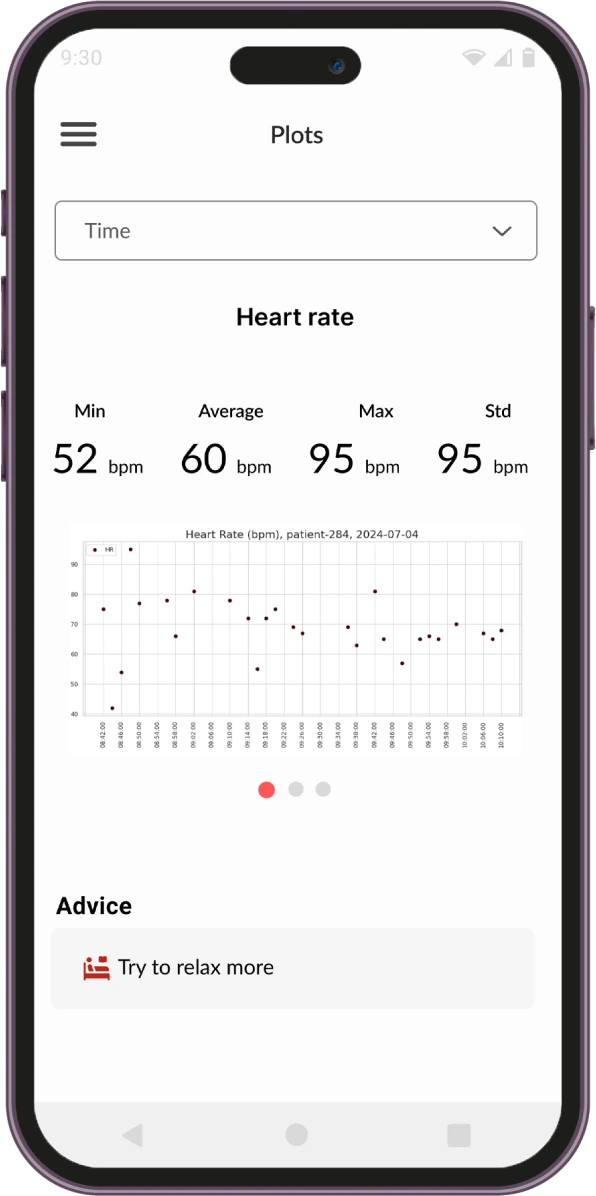
Platform screen with placeholder data
Demonstration values, not patient data
Simulated single-lead ECG trace with oscillating vital sign values for illustrative purposes. Clinical accuracy of production data depends on the paired device and its integration.
Signals and technologies we support
Cardiovascular
Continuous single-lead electrocardiogram. Photoplethysmography derived heart rate and heart rate variability. Pulse oximetry for peripheral oxygen saturation. Blood pressure through connected devices.
Neurological
Continuous EEG through X-trodes reusable dry-electrode systems, connected directly by API through VS CONNECT, activated per study and planned for the PT-EPI-DCT-002 study. Seizure event capture and structured investigator review workflows. Sleep architecture analysis from EEG and accelerometry is in development.
Metabolic
Continuous glucose monitoring (Dexcom): designed for, API authorisations in progress. Respiratory rate from PPG-derived and rPPG signals. Energy expenditure and metabolic activity through accelerometry.
Autonomic and dermal
Electrodermal activity capture; stress and autonomic response analytics are in development. Skin temperature. Respiratory waveform through multi-sensor fusion.
Activity and behavioural
Triaxial accelerometry for step count and activity classification. In development: gait metrics, sleep staging and sleep quality scoring, fall detection and posture recognition.
Contactless monitoring
Camera-based contactless vital sign extraction through remote photoplethysmography. Heart rate, respiratory rate, and stress indicators obtained from standard smartphone video without wearable hardware (in validation). Designed for decentralised studies where device burden must be minimised, and for remote screening and telehealth workflows.
Continuous monitoring, anywhere
Turn every patient into a connected data source with broad device integration.
Broad device integration
Unified integration layer for research, medical and consumer wearables, normalising heterogeneous device data into standardised FHIR R4 observations so any sensor in our catalogue can contribute to the same analysis.
Real-time data streaming
Continuous data ingestion; edge processing to save bandwidth is in development. Vital signs flow into the study database without patient intervention.
AI anomaly detection (in development)
In development: machine-learning models that flag anomalies in physiological data, such as arrhythmias, desaturation events and sudden vital-sign changes, for investigator review. Clinical-decision use follows the 2027–2029 clinical-AI timeline.
Automated safety alerts
Configurable alert cascades notify investigators, study coordinators, and medical monitors when patient data crosses safety thresholds. Tiered escalation with acknowledgment tracking.
Data normalisation
Heterogeneous device data normalised into standardised FHIR R4 Observation resources. Compare heart rate from a consumer wearable with a medical device in the same analysis.
Patient engagement
Patient-facing dashboards show health trends and encourage adherence. Gamification elements, achievement badges and personalised health insights to support device wear compliance are in development.
Signal-quality scoring
Automated signal-quality assessment for every data point. Flags motion artefacts, sensor disconnections and low-confidence readings before they enter the dataset.
A networked sensor fabric
Research devices, medical devices and consumer wearables flow into one unified device layer. Hover a category to highlight its place in the mesh.
Device categories
Continuous EEG through X-trodes reusable dry-electrode systems, connected directly by API through VS CONNECT, activated per study and planned for the PT-EPI-DCT-002 study.
Continuous glucose monitoring (Dexcom): designed for, API authorisations in progress.
Hover a category to highlight its corresponding node in the 3D mesh, or vice versa.
How it works
From device provisioning to real-time insights in three steps.
Connect devices
Select devices from the device compatibility matrix: a native research wearable, devices connected directly through VS CONNECT, and brands activated per study through Thryve. Patients pair devices through the mobile app with guided setup, no technical expertise required.
Stream and monitor
Continuous data flows from patient devices to the study database, and configurable threshold rules trigger safety alerts. AI analysis that flags anomalies in the streams is in development.
Analyse and act
Normalised, quality-scored data feeds the EDC and analytics modules, ready for device-data summaries and safety narratives.
See it in action
eHealth CTMS + RPM — Medication Reminder
Questions and answers
Remote patient monitoring questions
Which devices does Vitruvian Shield RPM support?
The Analog Devices research wearable is integrated natively and available. Corsano and X-trodes dry-electrode EEG connect directly by API through VS CONNECT and are activated per study. Fitbit, Garmin, Polar, Apple, Samsung, Withings, Omron, Oura, WHOOP and further brands are connected through Thryve aggregation and activated per study. Camera-based contactless vital signs through remote photoplethysmography are in validation. The device compatibility matrix lists every brand and its status. Continuous glucose monitoring (Dexcom): designed for, API authorisations in progress.
Which physiological signals can be collected?
Cardiovascular signals (single-lead ECG, PPG-derived heart rate and heart rate variability, pulse oximetry, blood pressure through integrated devices), neurological signals (continuous X-trodes dry-electrode EEG, connected directly through VS CONNECT, activated per study and planned for the PT-EPI-DCT-002 study), metabolic signals including Dexcom continuous glucose monitoring, autonomic and dermal signals, activity from accelerometry (sleep staging in development), and contactless vital signs from smartphone video (in validation).
How is signal quality handled?
Every data point receives an automated signal-quality assessment that flags motion artefacts, sensor disconnections and low-confidence readings before they enter the dataset. Device data is normalised into HL7 FHIR R4 Observation resources so readings from different devices can be compared in one analysis.
Can participants be monitored without visiting a site?
Yes. Participants pair their devices through the mobile app with guided setup, data streams continuously to the study team, and configurable alert cascades notify investigators, coordinators and medical monitors when a reading crosses a safety threshold.
Talk to us about your next study
Tell us about the protocol, the countries and the devices. We will show you how the platform would run it.